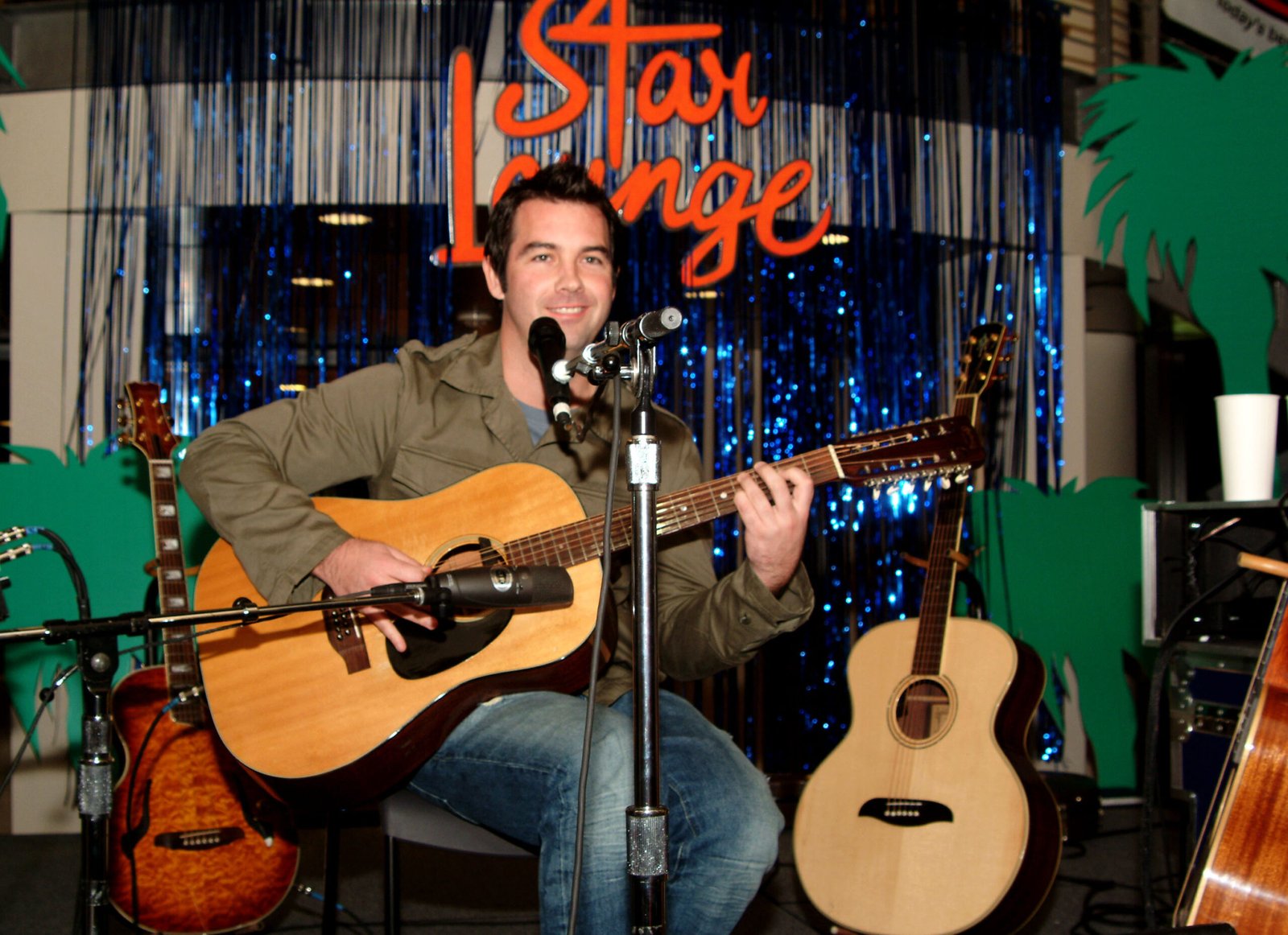
Duncan Sheik, the introspective singer/songwriter whose hit “Barely Breathing” became a defining mid-’90s pop song before he reinvented himself as a Tony-winning Broadway composer, died yesterday (Sept. 17) in Manhattan at the age of 56. His mother, Suzanne Sheik, confirmed his death to the New York Times, saying the cause was organ failure.
Sheik’s career was marked by a persistent tension between mainstream recognition and his own resistance to the machinery of pop stardom. Soft-spoken and cerebral, with a degree in semiotics from Brown University, he arrived in Los Angeles in 1992 carrying a demo tape and considerable discomfort with performing in public. “I could barely sing in public to save my life at that point,” he recalled in a 2011 interview.
Within a few years, however, Sheik had become an unlikely pop star. His self-titled 1996 debut, released by Atlantic Records, produced “Barely Breathing,” a melancholy portrait of a relationship coming apart wrapped in an irresistibly sweet hook. The song earned a Grammy nomination, reached No. 16 on the Billboard Hot 100 and spent 55 weeks on the chart.
The song’s success turned Sheik into something he never seemed particularly interested in being: a celebrity heartthrob. With his movie-star looks and female-heavy audience, the press cast him as a sensitive, soulful sex symbol. “Don’t hate Duncan Sheik because he’s beautiful,” critic Ann Powers wrote after a 1998 concert, “He is trying very hard to distance himself from that fact.”
That distance was audible in the music. Sheik’s influences ranged from Joni Mitchell and the Cocteau Twins to Estonian composer Arvo Pärt, while his lyrics drew on Buddhist philosophy and existential questions. His 1998 follow-up, Humming, was praised by the New York Times critic Stephen Holden for suggesting that “pop can still aspire to a lofty, searching classicism.” His third album, 2001’s Phantom Moon, made with poet and playwright Steven Sater, pushed further into that territory.
Sheik had little interest in playing the conventional pop star game. He later recalled that by the early 2000s, the “authenticity” of the alternative rock era had given way to the more overtly manufactured pop of Britney Spears, Christina Aguilera, ’N Sync and Backstreet Boys. “I thought, I’m not going to win in this game of trying to be Justin Timberlake,” he said in a 2022 interview. “Maybe I should try and do something different.”
That something different ultimately transformed his career. Sheik met Sater through their shared involvement with Soka Gakkai, a Buddhist organization, and in 1999 Sater approached him about collaborating on a musical based on Frank Wedekind’s 1891 play Spring Awakening. The project would take years to reach the stage, but when it opened on Broadway in December 2006, Sheik’s music helped radically recast what a contemporary musical could sound like.
Rather than writing traditional Broadway show tunes, Sheik and Sater created a rock score that drew on the emotional directness of alternative music. Sheik coached the young cast — including future stars Lea Michele, Jonathan Groff and John Gallagher Jr. — to avoid conventional Broadway vocal bombast. “Imagine that you’re Thom Yorke,” he told them. “Imagine that you’re a young David Bowie. Imagine that you are Fiona Apple. And please forget about all the vocal training you’ve ever had.”
The gamble paid off spectacularly. Spring Awakening won eight Tony Awards, including Best Musical, with Sheik taking home two: Best Original Score, shared with Sater, and Best Orchestrations. The production ran for more than two years on Broadway and was revived in 2015. A new production is scheduled to open off Broadway in November.
Sheik subsequently composed music for several other stage productions, including American Psycho, based on Bret Easton Ellis’ novel, and Alice by Heart, a Alice’s Adventures in Wonderland adaptation set in London during World War II. American Psycho opened on Broadway in 2016 but closed after a relatively short run.
Through it all, Sheik continued to make records outside the theater. His albums included 2011’s collection of covers of British ’80s acts including Depeche Mode and Tears for Fears, while his final studio album, Claptrap, arrived in 2022 with an ambient electronic soundscape.
Sheik was born Nov. 18, 1969, in Glen Ridge, N.J. His grandmother, who had studied at Juilliard, taught him piano beginning when he was 6. After his parents divorced, his mother moved to Hilton Head Island, S.C., where Sheik picked up his first electric guitar and played in a band covering Def Leppard and Van Halen. He attended Phillips Academy in Andover, Ma., graduating in 1988 before enrolling at Brown. There, he spent time in the campus recording studio developing his own material and played guitar with fellow student Lisa Loeb, who would score her own No. 1 hit with “Stay (I Missed You)” in 1994.
Sheik’s breakthrough came after several years in Los Angeles, but fame never sat comfortably with him. He later recalled being thrust onto Late Show With David Letterman and The Tonight Show With Jay Leno after releasing only one album and playing perhaps 30 or 40 shows. “I was put in situations that I didn’t have the experience to handle,” he said in 2003, adding, “I’m sure I sucked.”