In 2009, when Oasis broke up at Rock en Seine in Paris, I was there. In the throes of swine flu, I clutched a box of tissues I had taken from my friend Just Jack’s dressing tent. A wad turned soggy in my hand as I waited to see if this was just a garden-variety Gallagher argument—for the record, I have never witnessed Noel and Liam Gallagher exchange anything but good-natured banter—or if they were going to cancel, as they had the week before at the V Festival in Chelmsford.

The crowd was still chanting “O-AY-SEES” when it was confirmed Noel had already flown out of the festival grounds. I didn’t take the breakup seriously. This wasn’t the first time I’d traveled to an Oasis gig only for them to cancel because Noel—not Liam—was annoyed about something, with the blame always unfairly placed on Liam. I was mostly relieved to leave and lie down with this brutal flu.
A couple of years later, when I went to see Liam’s band Beady Eye, he apologized to me for canceling Rock en Seine. I believe he has apologized to anyone he’s encountered who told him they were there. If there was one good thing to come from Noel and Liam splitting, it was the eventual correction of Liam’s public image. Through radio programs, television chat shows, quirky magazine video series, and print interviews, his straightforward, humorous personality revealed his authentic self.
Which is why the opening of Oasis: Don’t Look Back in Anger is frustrating. It initially resurrects the hackneyed version of Liam, positioning him as the band’s scapegoat. But that quickly changes.
The two-hour film, created and written by Steven Knight (“Peaky Blinders”) and co-directed by Dylan Southern and Will Lovelace (Meet Me in the Bathroom), had complete access to rehearsals, shot 12 concerts across three continents, and interviewed the brothers separately and, more importantly, together. It begins with early footage of the band, including the historic Knebworth concerts at the first peak of their career. At first, it feels like a retread of the lackluster 2021 concert film Knebworth 1996.
Then it gets to the rehearsals for the 2025 world tour. Twelve hidden cameras captured the lead-up to Liam’s arrival and the brothers’ first meeting after 15 years of estrangement. The tension among the band members is palpable. It’s most visible with Noel. He says he can’t see himself on a stage with Liam. The cameras’ invisibility, along with their remote operators, makes the moment feel almost uncomfortably intimate.
When Liam bowls in, barely concealing his nervousness, and gets right into it as if no time has passed. The tension disappears when he starts singing. His presence and voice confirm that he is the essential final component.
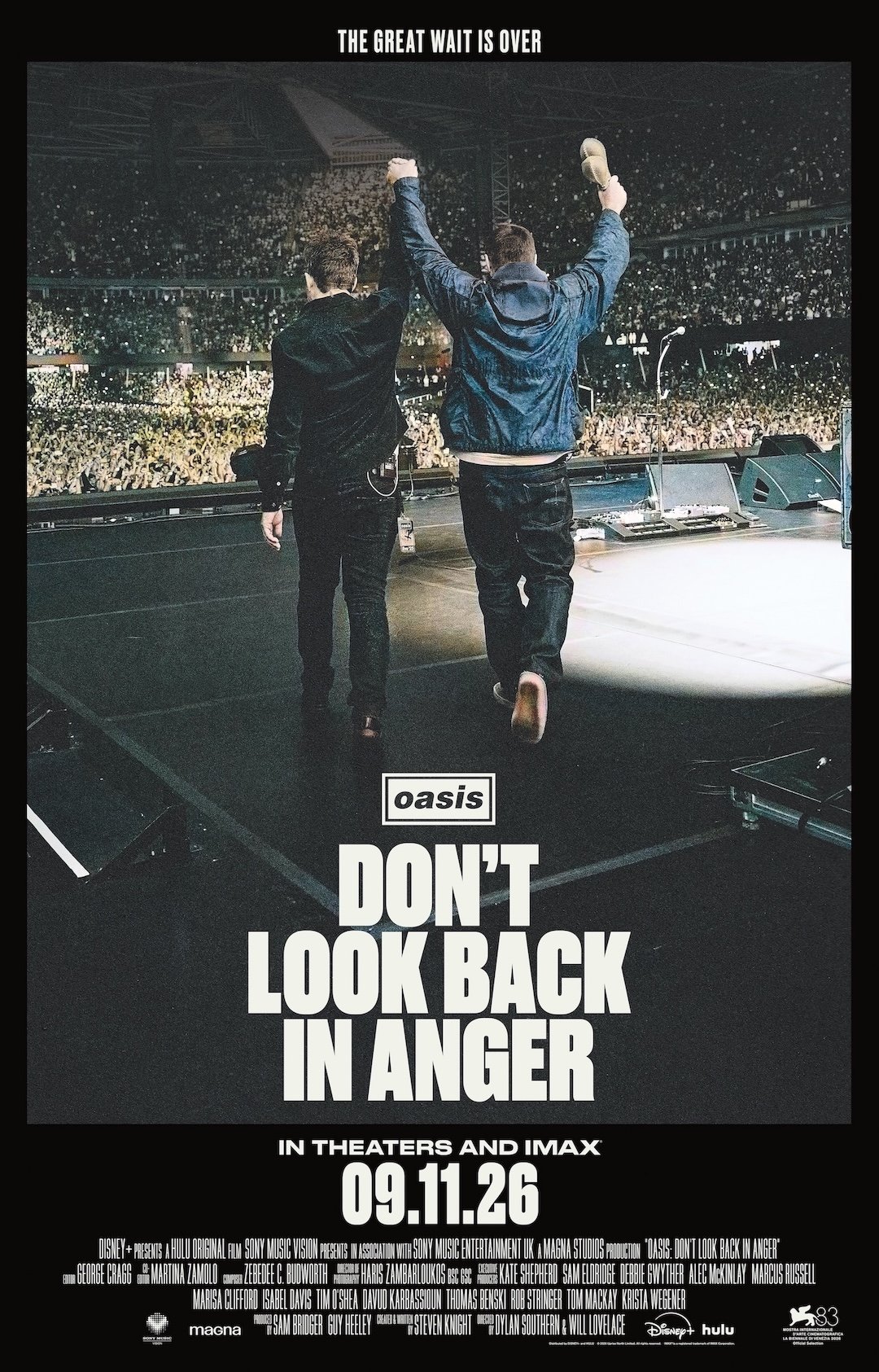
Don’t Look Back in Anger brings that global run to IMAX screens. The first, in Cardiff, Wales, locks onto the energy of the city and its fans. As Noel and Liam connected backstage before making their way to the stage, I got unexpected chills. That viral moment of the brothers holding hands, arms raised as they walk out, is shown from a different angle than the millions of posts about it. Seeing it from their side makes the occasion feel even more historic. Then Liam starts singing and I start crying.
My tears are mirrored on screen as the cinematographers give the audience as much attention as the band. Cameras move close enough to see fans’ pores, then soar above the stadiums for bird’s-eye views. Thousands of hours of footage have been edited to give you the band’s perspective, the fans’ perspective, God’s perspective. It’s stupendous. Stadiums of people jumping, moving their arms, and singing in time across multiple shows around the world is moving, to say the least.
Like Knebworth 1996, the fan experience is central, but unlike that film, this is the real thing. None of the fans interviewed experienced Oasis in the ’90s. As one points out, they have only ever seen the band on a small screen. For them, these shows carry particular significance as they recount moments when Oasis’ music was their lifeline, its lyrics echoing their experiences.
Noel says he spent much of the shows turned away from the audience because he was so emotional at their reaction, particularly when he saw fathers and sons singing his songs back to him. The word joy makes me cringe, but after watching this film, I witnessed what true joy looks like, both from the band and the fans.
During the Dublin segment, and again toward the end, an Irish priest talks about forgiveness, brotherhood, and togetherness. It’s a sermon, but he’s talking about Oasis. What he says reflects not only the universality of the music, but the dynamic between Liam and Noel.
Early in the film, Noel says he never forgives anyone. By the end—and I’m paraphrasing here—he says he forgot how much people want and need Liam, how Liam can just rock up and smash it, how he can put a tambourine on his head and, instead of looking like an idiot, look amazing. Saint-like, as I describe it.
Their joint interviews are hugely entertaining, with the banter I referenced earlier in full effect, extending to the unseen interviewer. Noel calls his brother a delight. It’s a redemption for Liam in a way that only Noel can validate.
If you attended any dates on the Oasis Live 25 Tour, this film is better. If you didn’t, you are going to have the worst FOMO of your life. It’s a must-see for fans. If you’re a casual listener and catch it when it turns up on Disney+ or Hulu, I guarantee you’ll be queuing up for tickets for 2027—which are rumored to be announced next week.
I woke up this morning thinking about the film and still basking in the feel-good vibes it activated. That didn’t happen after I went to the Los Angeles dates at the Rose Bowl, the first of which I reviewed. The second night was significantly better. This documentary bests them both.
Don’t make the mistake I did and dress like you’re just going to the movies. Grab your bucket hat and Oasis merch, make sure you have at least one Adidas item on you, and catch Oasis: Don’t Look Back in Anger on the big screen, ideally in IMAX.