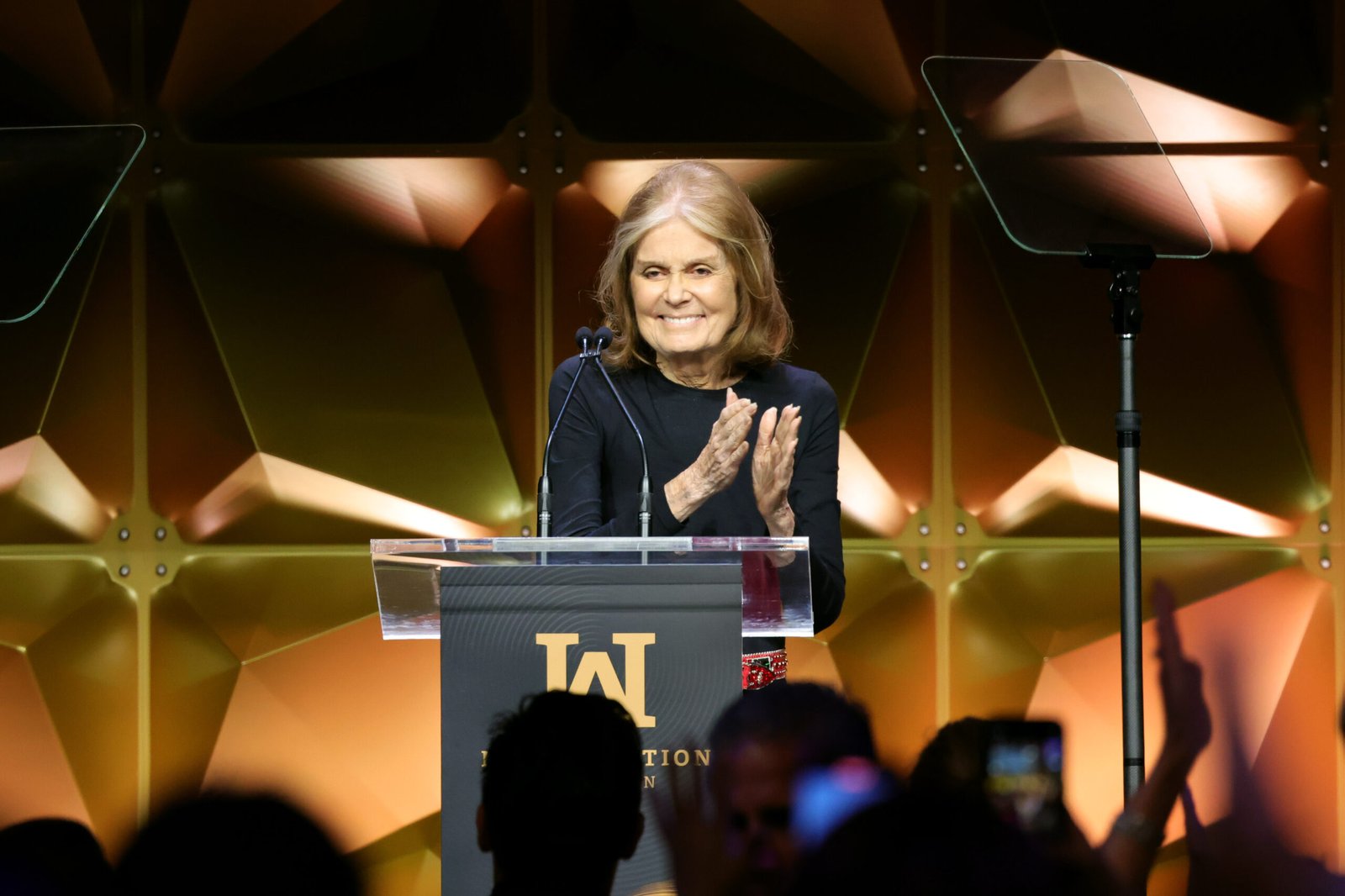
Gloria Steinem, the writer, organizer and unmistakable public face of the modern feminist movement, died yesterday (Sept. 3) at her home in New York, according to her foundation. For more than six decades, Steinem turned journalism, public speaking and grassroots organizing into instruments of social change, helping move issues including reproductive freedom, gender equality and women’s political representation from the margins into the center of American life.
Steinem’s route to becoming an icon was anything but conventional. Born in Toledo, Ohio, in 1934, she spent much of her childhood traveling the country with her father, eventually studying at Smith College before spending two years in India. She returned to the U.S. and built a career as a journalist at a time when women writers were routinely steered away from politics and toward subjects deemed more appropriate for their gender. Her breakthrough came in 1963, when she went undercover as a Playboy Bunny for an exposé on the treatment of women working at the clubs. The experience sharpened her understanding of the gap between the freedoms advertised to women and those actually available to them.
Steinem would eventually help launch New York magazine in 1968, but the limitations placed on her journalism helped push her toward activism. An illegal abortion she underwent at 22 had already left a lasting impression; years later, attending a 1969 abortion-rights speak-out became, in her words, the beginning of her activism. She came to see reproductive autonomy not as a discrete “women’s issue,” but as a fundamental question of equality and democracy.
In 1972, Steinem co-founded Ms. magazine, creating a publication that gave the burgeoning women’s movement a national platform and made subjects including abortion rights, sexual harassment, equal pay and discrimination impossible to dismiss as peripheral concerns. She remained associated with Ms. for decades, while also helping establish the National Women’s Political Caucus and other organizations devoted to putting women into positions of political power and broadening the movement’s reach.
Steinem’s genius was partly one of translation. She could take ideas that had lived largely inside activist and intellectual circles and articulate them in language that reached a mass audience. She became famous for her writing, but equally important was her willingness to get on the road — to college campuses, community centers, rallies and marches — and make feminism a lived, collective conversation. She never learned to drive, yet spent much of her life in transit, turning the road itself into an organizing tool and eventually the subject of her 2015 memoir, My Life on the Road.
That visibility also made Steinem a lightning rod. Critics challenged her privileged background, her celebrity and the degree to which the media treated her as the singular face of a movement that had always been larger and more diverse than any one person. Steinem herself resisted that characterization. Yet her ability to bridge different factions of feminism — and to bring its arguments into mainstream culture — was precisely what made her so consequential. Reuters notes that she helped shape the second wave of feminism while also emphasizing the intersection of race and gender and championing the stories of women whose experiences had long been ignored.
Her activism never stopped at the boundaries of feminism. Steinem was involved in campaigns for the Equal Rights Amendment, voting rights and broader civil and social justice causes, and she continued to speak publicly about reproductive rights decades after the movement first made her a national figure. Even in her 90s, she remained engaged with younger activists and contemporary movements, approaching the work less as a finished political victory than as an ongoing conversation about power, equality and human dignity.
In the ’90s, as musicians such as Pearl Jam made abortion rights a key issue, Steinem became involved with organizations like Voters for Choice, which helped educate young people about the importance of participating in the political process. Pearl Jam and Neil Young led a 1995 benefit for the group in Washington, D.C., and in the lead-up to the 2004 U.S. presidential election, Steinem went on the road with the band Le Tigre to spread the pro-choice message anew.
Her cultural footprint extended well beyond the organizations she founded or the legislation she fought for. Steinem became a symbol whose image — center-parted hair, large glasses, turtlenecks and an ever-present notebook or microphone—was instantly recognizable, but her deeper legacy was less about the iconography than the permission she gave others to speak. Her writing and activism helped establish the idea that personal experience could be political evidence, and that stories traditionally dismissed as private could expose larger systems of inequality.
In 2013, President Barack Obama awarded Steinem the Presidential Medal of Freedom, the nation’s highest civilian honor. Her books included Outrageous Acts and Everyday Rebellions, Marilyn: Norma Jean, My Life on the Road and later works exploring aging, self-esteem and the continuing struggle for equality. Her life was also repeatedly brought to the screen, reflecting the unusual degree to which a writer and organizer became a figure of popular culture herself.
Steinem once said that if editors had been willing to let her write about the women’s movement, she might never have become a public speaker. Instead, she overcame her fear of speaking and spent the rest of her life doing it — on stages, in classrooms, on television and alongside activists. That evolution neatly captures her larger contribution: she understood that changing the culture required not only arguments, but voices; not only publications, but people; not only laws, but a willingness to keep showing up. The movement she helped bring into the mainstream was always bigger than her, but for generations of women — and for many of the artists and activists who carried those battles into popular culture — her voice helped make it possible to imagine something different.