In a musical world constantly searching for what comes next, Avohee Avoher is finding his future by drawing inspiration from the masters of the past.
The classically trained composer, pianist and electronic artist has developed a distinctive musical identity built around a simple but powerful idea: tradition doesn’t have to remain frozen in time. It can be studied, challenged, transformed and used as the foundation for something entirely new.
His new single, “Valenor,” brings that philosophy vividly to life.
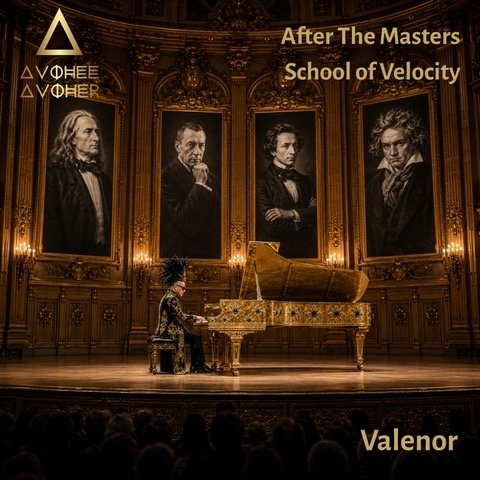
“Valenor” opens Avoher’s ambitious project After the Masters – School of Velocity, a collection of original compositions inspired by the musical and technical achievements of history’s great piano masters.
But this isn’t an exercise in recreating classical music from another century.
Avoher takes the discipline, virtuosity and musical language of the past and pushes them into his own contemporary world, creating music that respects tradition without being controlled by it.

A Different Kind of Virtuosity
From its opening moments, “Valenor” puts the piano in motion.
Built around a dramatic minor-key foundation, the composition races through rapid passages, shifting rhythms, syncopation and rising harmonic tension. There’s considerable technical firepower in the performance, but the speed isn’t there simply to show what Avoher can do at the keyboard.
It serves the music.
And more importantly, it serves the emotion.
That distinction sits at the heart of Avoher’s work. His compositions aren’t designed to tell listeners exactly what they’re supposed to feel. Instead, they create an emotional landscape and allow each listener to experience it differently.
“Valenor” can feel cinematic and expansive in one moment, then surprisingly personal and intimate in the next.
Classical technique provides the vocabulary. Avoher decides what to say with it.
From 12V to After the Masters
“Valenor” also marks an intriguing progression from Avoher’s previous project, 12V, a twelve-track collection built around the idea of different emotional “voltages.”
With 12V, Avoher explored instrumental music’s ability to awaken memories, emotions and personal interpretations without prescribing a specific story or emotional destination.
After the Masters – School of Velocity takes that freedom in another direction.
This time, the music introduces speed, technical pressure, rhythmic momentum and the sheer physical possibilities of the piano.
It’s another chapter in a career that has rarely stayed inside one musical lane.
Avoher has moved between expressive piano compositions and contemporary electronic productions, carrying elements of his classical background into music created for entirely different environments.
His catalog includes works such as “Noema,” “Tremura,” “Malami,” “La Noche Resonaba” and Avohee Meets Bach, alongside the 12V project.
That range has become an important part of Avoher’s artistic identity: classical discipline without artistic confinement.

“Valenor” Connects Past and Future
Perhaps the most compelling aspect of “Valenor” is the conversation it creates between musical history and contemporary creativity.
Generations of virtuoso piano writing can be felt in its DNA, but Avoher doesn’t treat the great masters as the final word.
He treats them as the beginning of another conversation.
For an artist whose music crosses classical composition, cinematic atmosphere and modern electronic production, “Valenor” feels less like a departure than a natural evolution.
It’s not about abandoning the past.
It’s about asking what can happen when an artist respects that past without being afraid to move beyond it.
With After the Masters – School of Velocity, Avohee Avoher poses an intriguing question:
After centuries of extraordinary music, where can the piano go next?
“Valenor” suggests he’s determined to find out.
“Valenor” by Avohee Avoher is available now on major streaming platforms.
Official Website:
https://avohee.com/
Listen on Spotify:
https://open.spotify.com/artist/7qmylYYDrduXxzjHFkfmai